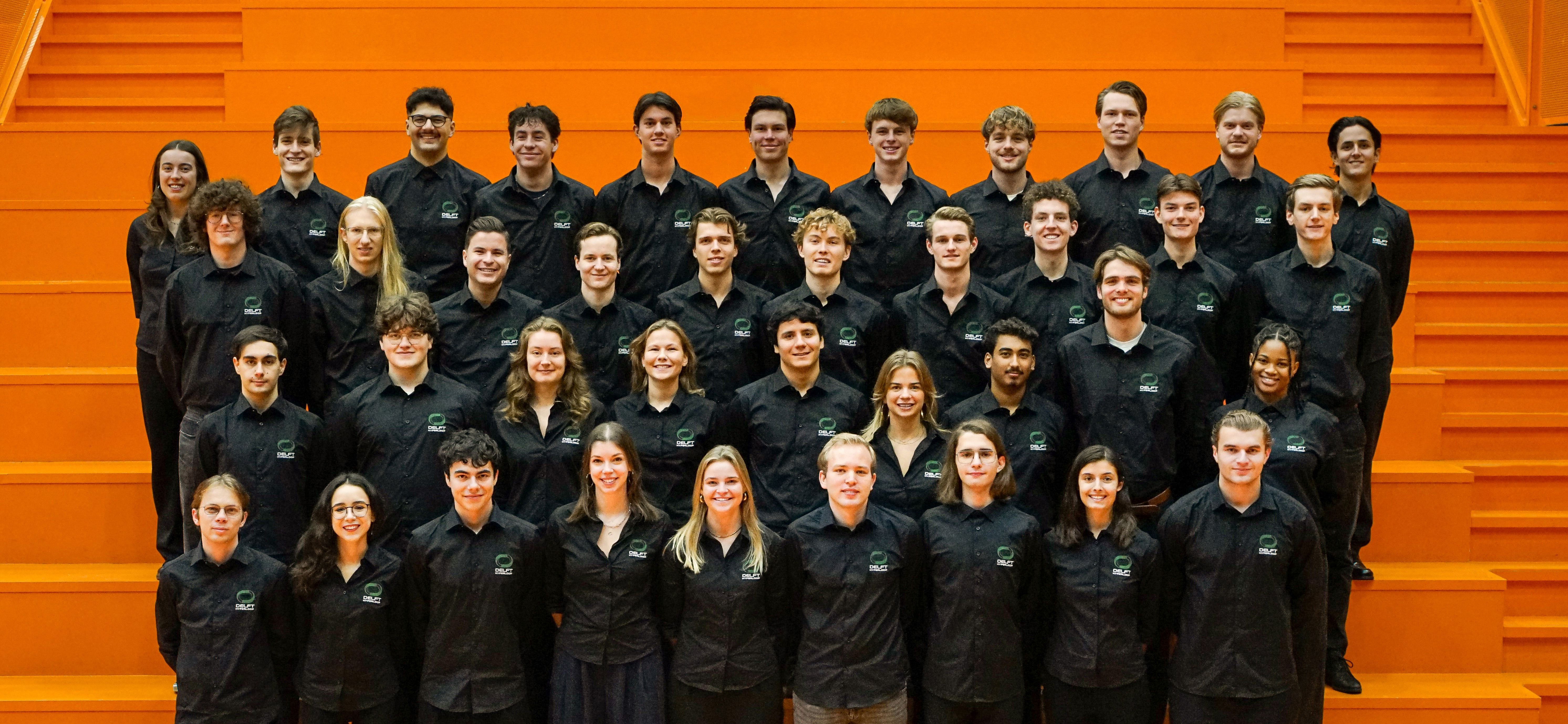
Delft Hyperloop team members rolling the pod THEIA II towards the test tube at the European Hyperloop Center in Veendam

DELFT HYPERLOOP XI

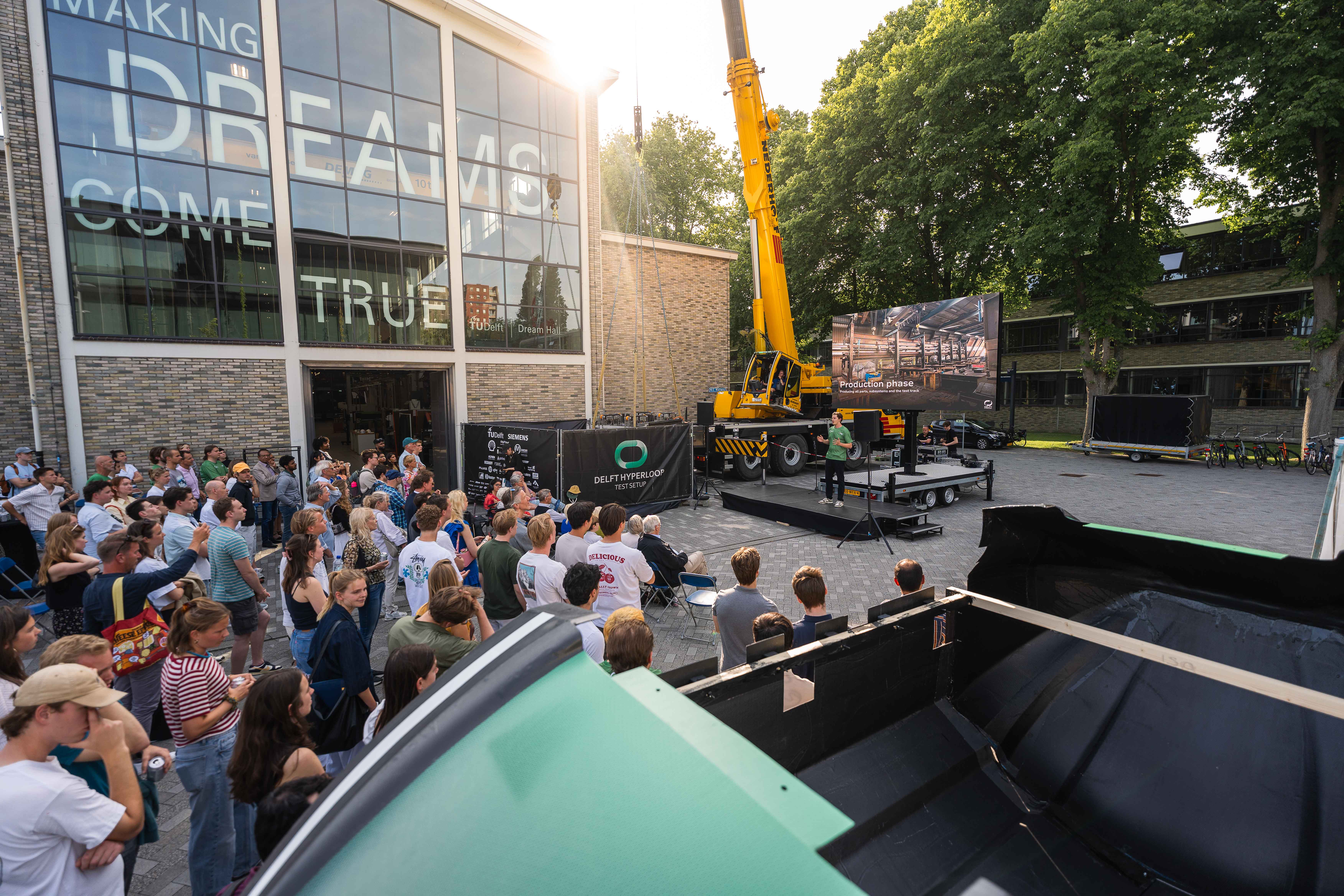
We are 45 TU Delft students working full-time on one hyperloop pod. In this photo, last year's team rolls THEIA II into the test tube in Veendam. In July 2027, it's our turn.

OUR STORY

SCHIPHOL TO BERLIN

A full-scale hyperloop from Schiphol to Berlin would cover about 600 km. Here is how long the trip takes today, and how long it would take by hyperloop.

Train
5 h 42 min
Plane
1 h 20 min
Hyperloop
55 min

Train: fastest direct ICE from Amsterdam Centraal to Berlin Hbf. Plane: time in the air from Schiphol to Berlin Brandenburg, so without check-in, security and getting to and from the airport. Hyperloop: the travel time a full-scale hyperloop system is designed for on this route. Our student pod tests the technology behind it, not this top speed.
Loading the map

About this mapThe network on this map is our own sketch, not an official plan: 23 stops and 7,031 km of tube, drawn as straight lines between cities. Travel times are estimates. They use the speed profile of a full-scale hyperloop designed to link Schiphol and Berlin in 55 minutes: 5 minutes to speed up, 5 to slow down, and about 700 km/h in between, without stops. The train time (5 h 42 min) is the fastest direct ICE from Amsterdam to Berlin. The plane time (1 h 20 min) is the time in the air from Schiphol to Berlin Brandenburg. The pod in the tube is shown by its outer shell only: the aeroshell of THEIA, built by Delft Hyperloop IX.

UPCOMING EVENTS

LEARN MORE

THE HYPERLOOP CONCEPT

LEARN MORE

MEET DH XI

MEET THE TEAM

STAY IN THE LOOP

Get our monthly newsletter: progress on our pod, upcoming events and the road to the European Hyperloop Week 2027.

Thanks! You're on the list for our next newsletter.
Oops! Something went wrong while submitting the form.
TU Delft Dream Team · since 2015

Delft Hyperloop XI

Students building the fifth mode of transport. Scroll to launch the pod.

01 · Levitation

It floats.

THEIA II hangs under its track. Electromagnets hold it in the air: no wheels, no friction, almost no noise.

02 · Propulsion

It accelerates.

A linear motor pushes the pod forward without ever touching the rail.

03 · Coupling

Two pods, one train.

Our autonomous coupling mechanism links pods together, so a hyperloop can carry more people at once.

04 · Low pressure

Almost no air.

Inside a low-pressure tube there is barely any drag, so speed costs very little energy.

05 · Arrival

Schiphol to Berlin in 55 minutes.

That is what a full-scale hyperloop is designed for. Our pod tests the technology behind it.

0KM/H
SchipholBerlin
Departure · 0 of 600 km
Scroll ↓