THIS IS THEIA II

Take a closer look

DH10 IS CARGO READY

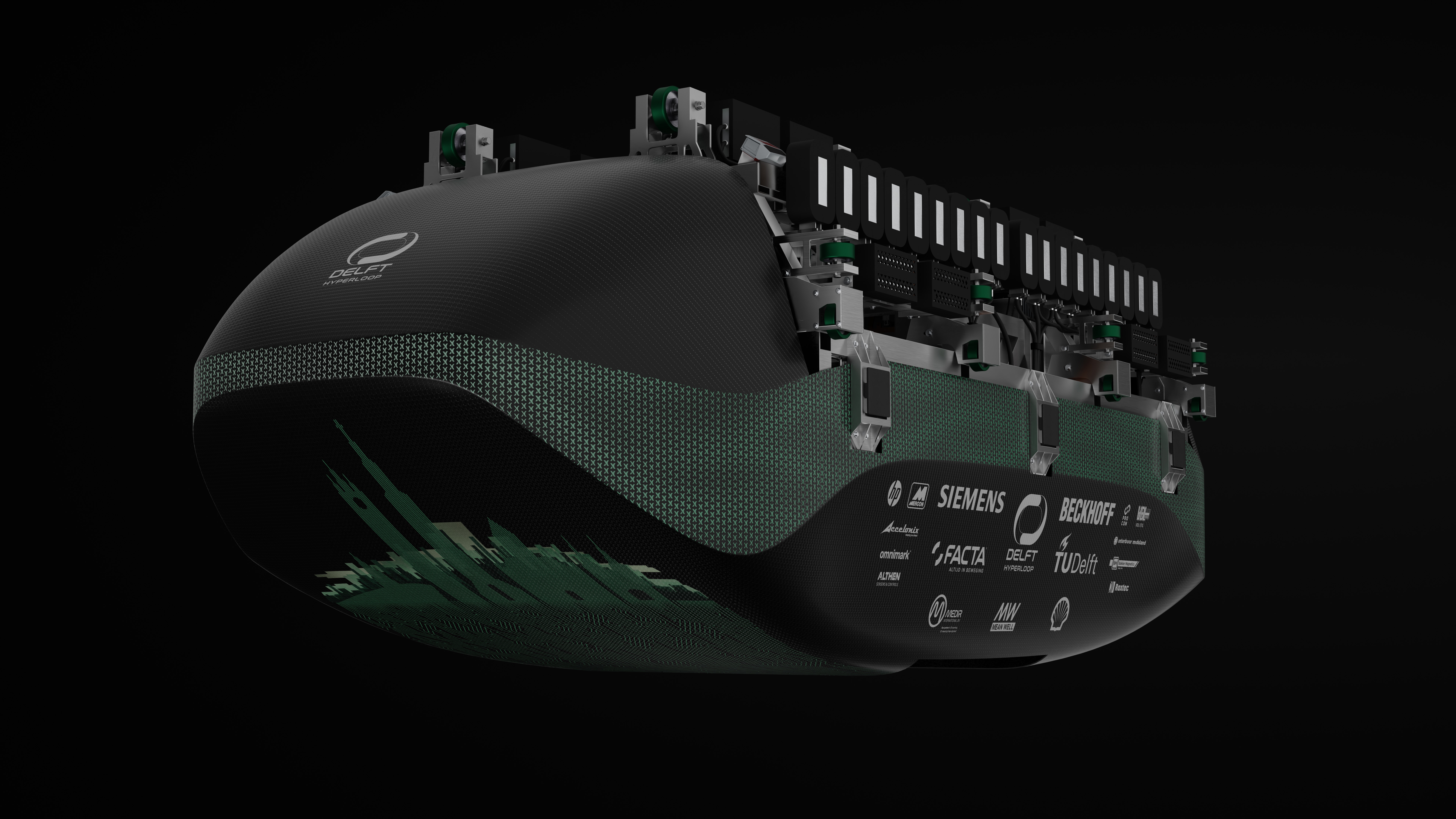
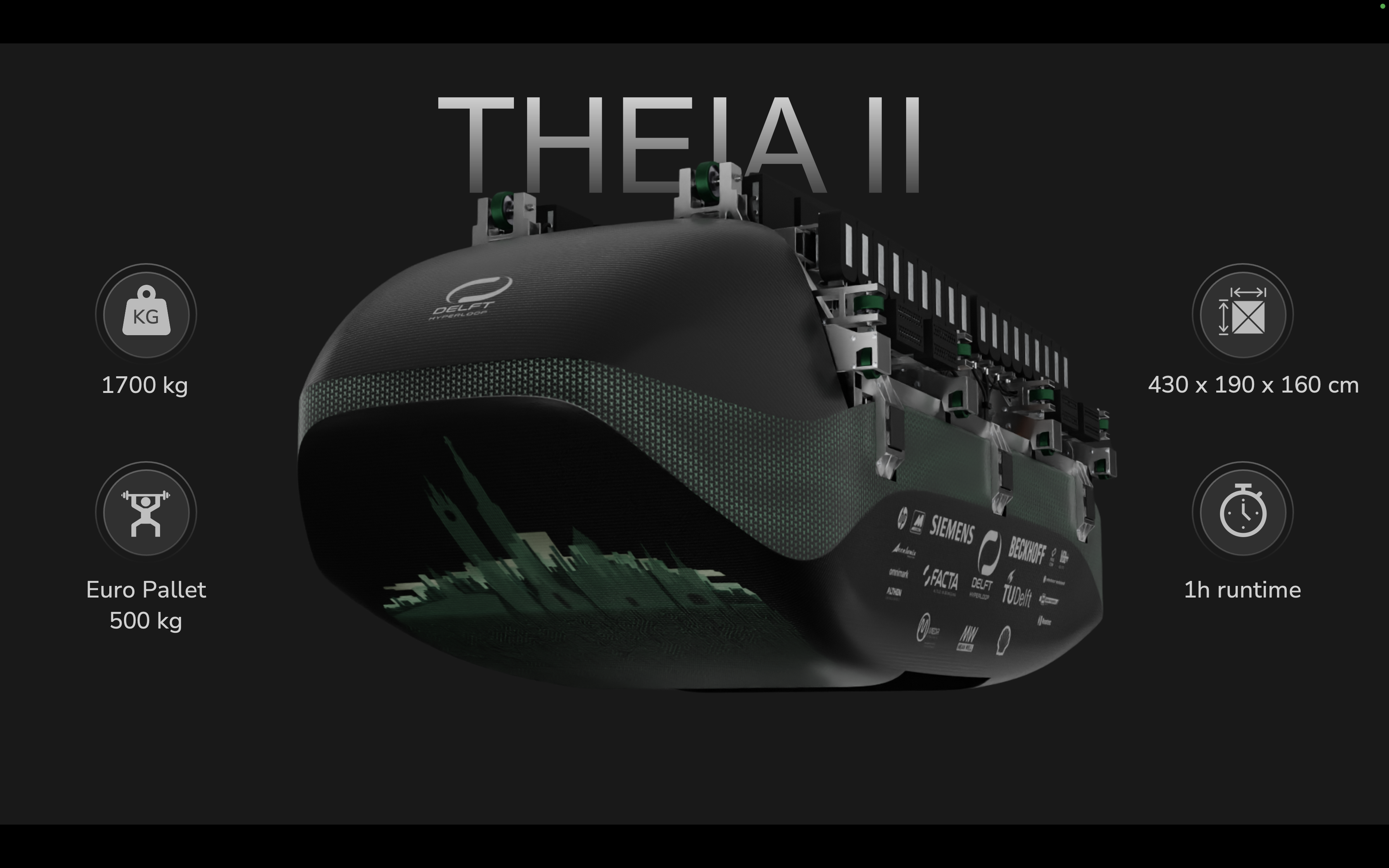
We proudly present THEIA II, the pod of Delft Hyperloop X. This year's goal was to demonstrate a hyperloop system that can carry 500 kg of cargo while optimising endurance. THEIA II can levitate with an extra 500 kg on board, carries a standard Europallet in its new Cargo Operation System and reached a runtime of 1.5 hours on our test setup in Delft. We presented the design at the European Hyperloop Week 2026.

THEIA II

THEIA II is the pod of Delft Hyperloop X. Our goal was to demonstrate a hyperloop system that can carry 500 kg of cargo while optimising endurance. We see cargo as an important step towards passenger transport: it lets us make the technology robust before adding the complexity of carrying people.

Take a look at the different subsystems to see how we made this possible.

THEIA II has an empty mass of about 1.7 tonnes and can levitate with an extra 500 kg of cargo. On our test setup in Delft, the pod reached a runtime of 1.5 hours.

The pod carries a standard Europallet in its Cargo Operation System, levitates on 8 HEMS and 8 EMS modules, is driven by four independently controlled linear motors and runs on a 600 V battery system with a capacity of 6 kWh.

MECHANICAL

The Mechanical department designs and builds the structure of the pod. This year the chassis was designed around one goal: carrying cargo. It is made of T6-series aluminium, which gives a good balance of low weight, high strength and stiffness, and it has an open space in the middle for the Cargo Operation System (COS).

With the COS we aim to set a hyperloop cargo standard, like the standardised cargo interfaces used in aviation. Its dimensions are based on a standard Europallet, so it fits current cargo infrastructure. The structure around the pallet works as a container-like interface.

Four electronic cargo locks, based on the principle of container locks, hold the load in place. They detect whether cargo is present and lock and unlock electronically.

Cargo is loaded from underneath. In a tube, loading from the side or top is difficult, because the pod is surrounded by the tube and its tracks. Loading from below lets cargo be inserted from outside the tube while the pod stays on the track.

LEVITATION

Carrying cargo is a big challenge for the levitation system: it has to lift the pod both with and without 500 kg extra, and still let go of the track safely. The system was designed around three requirements: enough lift to reach the zero-current airgap with cargo, the ability to detach from the track without cargo, and enough permanent-magnet force across a range of airgaps and masses.

Vertical levitation uses 8 HEMS (Hybrid Electromagnetic Suspension) modules, each with an iron U-core, two coils and two permanent magnets. They carry the empty pod at a 16.7 mm airgap and the pod with 500 kg of cargo at 13.5 mm. Lifting the payload from the bottom position takes 3.7 A, and once the pod levitates stably it needs only 0.1 kW.

For lateral stability, 8 EMS modules keep the pod centred and counteract the motor forces using feed-forward control.

Software keeps it all stable: extra force and sensor rejection when a magnet passes a thermal expansion gap in the track, an extra control loop that automatically finds the levitation position with the lowest power use for any payload, and notch filters that remove resonances.

PROPULSION

The propulsion system has four independently controlled motors. That lets us balance the forces of each motor, which improves stability and lays the basis for future active vehicle control. The main design goal was endurance: a motor that can do run after run without being limited by temperature.

The control system uses ETML (Equalizing Thrust, Minimizing Lift), which spreads thrust over the motor segments to maximise forward force while keeping unwanted lift low. The controller switches between current control for precise force and velocity control for a target speed, and an automated deceleration sequence brings the pod to a controlled stop.

The motor topology was chosen to fit the infrastructure of the European Hyperloop Center. Simulations showed that a shorter motor core actually performed better, so we saved weight and gained performance. Thicker copper windings, high-temperature epoxy and carbon-fibre-infused 3D-printed casings keep the motor reliable at higher temperatures.

Pneumatic brakes are held open by 50 bar of air pressure. When braking is needed, the air is released and springs push the brake pads against the track with a total force of 17 kN.

SENSE & CONTROL

Sense & Control builds the central nervous system of the pod. The HEMS, EMS, motors, cooling and powertrain all have to work together, so almost the full system runs in a real-time environment, with EtherCAT as the communication platform: an industrial protocol known for its reliability and speed.

A main finite state machine enables or disables the subsystems depending on the state of the pod. Levitation uses 12 laser triangulation sensors for feedback, and the motor gets its position from two barcode-scanning lasers with an accuracy of a tenth of a millimetre.

Test data leaves the pod over a wireless link to the ground station, using Cisco Ultra-Reliable Wireless Backhaul. Its make-before-break protocol gives zero downtime when switching between access points, a possible basis for wireless communication in future hyperloop systems. A Splunk database takes in the test data live, so every run can be compared with earlier tests.

POWERTRAIN

Powertrain provides the electric power for the pod, designed for reliability and endurance. For the low-voltage system we took inspiration from electric vehicles: a 24 V power rail with local step-down converters keeps power losses low, and blade-style fuses make every component quick to service.

The main actuators run on a 600 V high-voltage system with a capacity of 6 kWh. It powers the HEMS, EMS and motors and can sustain a continuous load of more than 50 kW.

The system has an in-house designed Battery Management System and Powertrain Controller, combining our own electronics with off-the-shelf components from our partners.

THERMAL

THEIA II is the first pod with a dedicated thermal department. In a vacuum, with no contact with the track, cooling by convection or conduction isn't possible. After looking at low-pressure evaporation, radiation and thermal storage, the team chose temporary heat storage: a solution that works today and stays useful in the future.

The motor is the biggest heat source. It is cooled by water flowing through aluminium microchannels only 2.5 mm thick. In tests, the cooled coils stayed at 70 °C at the moment the uncooled coils overheated at 95 °C after 26 minutes. Simulations show the cooled coils last about 3.5 times as long.

The motor heat goes into 15 kg of phase change material (PCM), which can store about 4.7 MJ. After a run, the cooling loop is connected to cold water to solidify the PCM again. The levitation coils are cooled with cold plates and have their own 25-litre water vessel, because the permanent magnets can't get as hot as the motor coils.

OUR GOAL

DH10 aims to demonstrate a hyperloop system that can carry 500 kg of cargo while optimising endurance, in the European Hyperloop Center.

CARGO

We see cargo transport as an important step towards passenger transport: it lets us make the technology robust before adding the complexity of carrying people. That's why THEIA II can carry up to 500 kg of cargo on a standard Europallet, held in place by four electronic cargo locks and loaded from underneath, just as it could be in a future hyperloop tube.
ENDURANCE

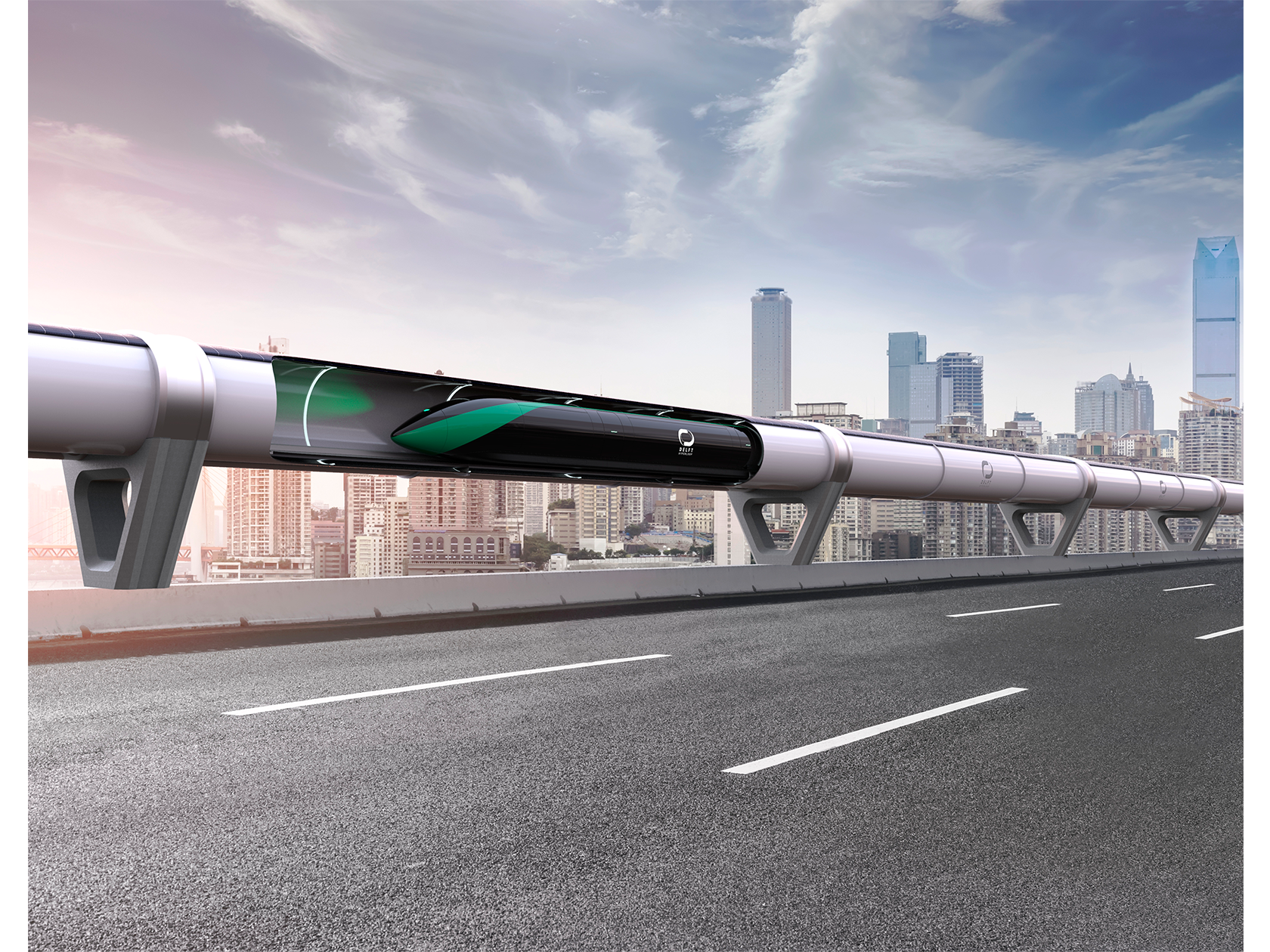
A hyperloop shouldn't just work once, it has to run reliably for long periods. That's why THEIA II was designed for endurance: levitation that needs only 0.1 kW once stable, a motor built to handle heat, and a new thermal system that stores heat during a run. On our test setup in Delft, the pod reached a runtime of 1.5 hours.
EHC

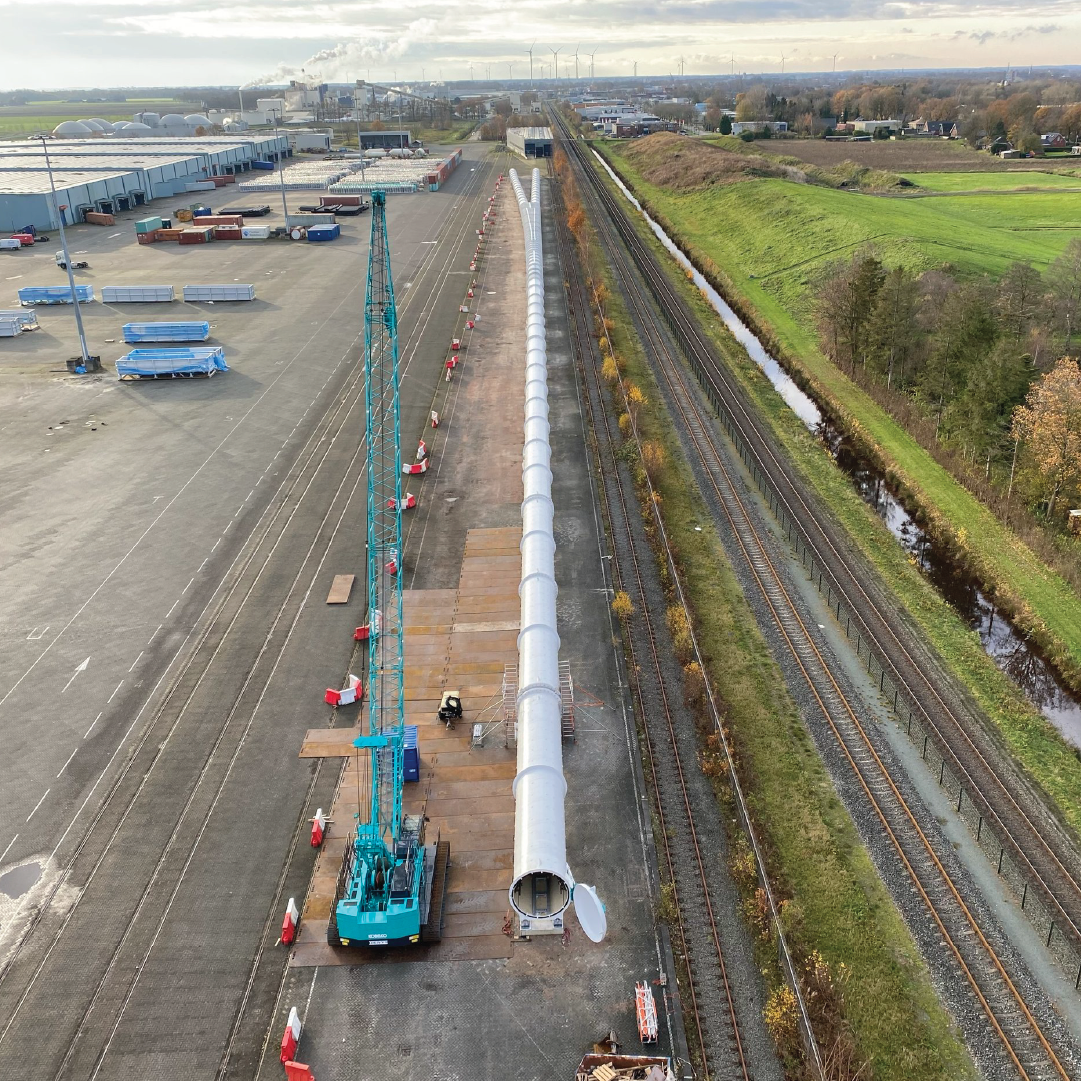
The European Hyperloop Center (EHC) in Veendam, Groningen, is a non-profit organisation dedicated to accelerating hyperloop development, with a test track that makes the Netherlands a centre of hyperloop innovation. THEIA II's motor was designed to fit the EHC's infrastructure, so it can be tested on a realistic track while staying scalable for future hyperloop systems.